
Join the CIVIS Biochemistry Webinar Series
The CIVIS biochemistry webinar series starts again on 9 October 2026. Each week a researcher from one of the CIVIS universities presents their current work. Talks last about 40 minutes …
The CIVIS biochemistry webinar series starts again on 9 October 2026. Each week a researcher from one of the CIVIS universities presents their current work. Talks last about 40 minutes …

Can a protein found in lake samples help scientists switch brain cells on and off? Our new YouTube Short tells the story of HulaCCR1, a light sensitive protein discovered by …

Prozomix, a partner in the BLUETOOLS consortium, has become the first biotech company in the world to contribute to the UN Cali Fund. In a new LinkedIn article, Prozomix CEO …

The BlueTools project will take part in BIOSPAIN 2026 in Bilbao, one of Europe’s leading biotechnology events. Together with our Horizon Europe sister project BlueRemediomics, BlueTools will host the session …
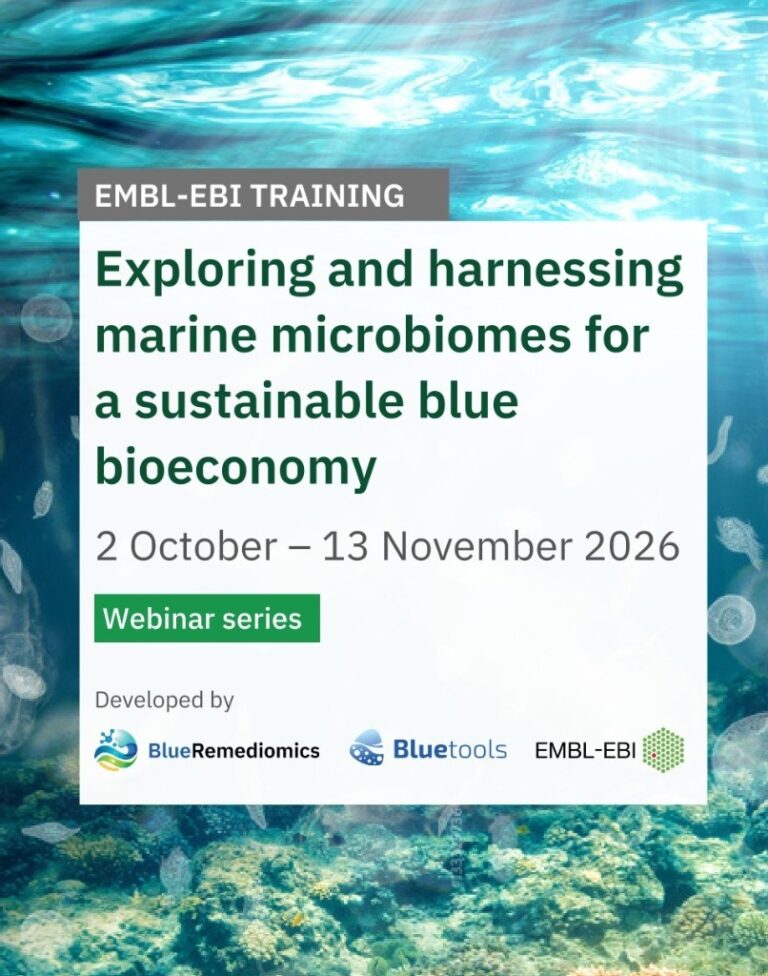
EMBL-EBI, with support from BlueRemediomics and BlueTools, is launching a new webinar series titled Exploring and Harnessing Marine Microbiomes for a Sustainable Blue Bioeconomy. The series is aimed at researchers …

Scientists have known about a small molecule called queuosine, or Q, for decades, but never understood exactly how it works. Bluetools researchers have now uncovered its role, and the discovery …
Imagine turning all the plastic already out there back into good quality plastic, instead of something worse. That is the idea behind a new BlueTools video. It follows scientists on …

From 6 to 9 July 2026, the joint BlueRemediomics and BlueTools final conference brought together both consortia at the picturesque EMBL campus in Heidelberg, Germany, to celebrate almost four years …

Bluetools researchers have developed a new ultrahigh throughput screening method to find genes that interfere with bacterial communication. The study identifies a previously unknown mechanism from one of Earth’s most …

A new open-access database is helping scientists unlock the secrets of how microorganisms produce complex molecules with powerful biological properties. Bluetools researchers have contributed to the development of MITE — …